
Pro Skill Packs, 2026-10-04. Every number comes from data.csv (one row per listed skill) and summary.json, produced by the scripts in this folder. There is no model judging: job categories come from the published keyword rules in analyze.py, everything else is a regular expression, a file listing or arithmetic. Findings are aggregate. Publishers are named only by their share of the public leaderboard.
Method
- Took the top 100 skills on skills.sh by all-time installs (the leaderboard embedded in the site, 2026-10-04).
fetch.pyfound eachSKILL.mdwith one GitHub tree listing per repo and one raw fetch per file, 0.5 seconds apart.resolve.pymade a second try for files whose folder name differs from the skill name.analyze.pyclassified each skill and measured it. Category rules are tried on the skill's name first, then on its description if we fetched it. A rule matches a whole word, or a word start for keywords of 5 or more letters. First matching rule wins. The rules, in order: workspace apps, image and video generation, marketing and sales, UI design, cloud and vendor platforms, agent and browser tooling, dev workflow. Audience follows the category: developer, business (workspace apps, marketing) or creative (media).- "Says when to use" means the description matches a phrase such as "use when", "when the user" or "should be used when".
Sample
- 100 listed, 71 fetched, 29 not. Reasons: 27 have a vendor domain as their source rather than a GitHub repo (3 of those skill ids were fetched from a GitHub source, 24 were not); 1 was removed from its repo; 1 has no folder or name that matches. Our portability study fetched 69; the extra 2 here come from matching on the
namefield. - Categories and publishers cover all 100. File measures (length, description, scripts) cover the 71.
- 98 skills were classified from the name and 2 from the description. None fell outside the rules.
Findings
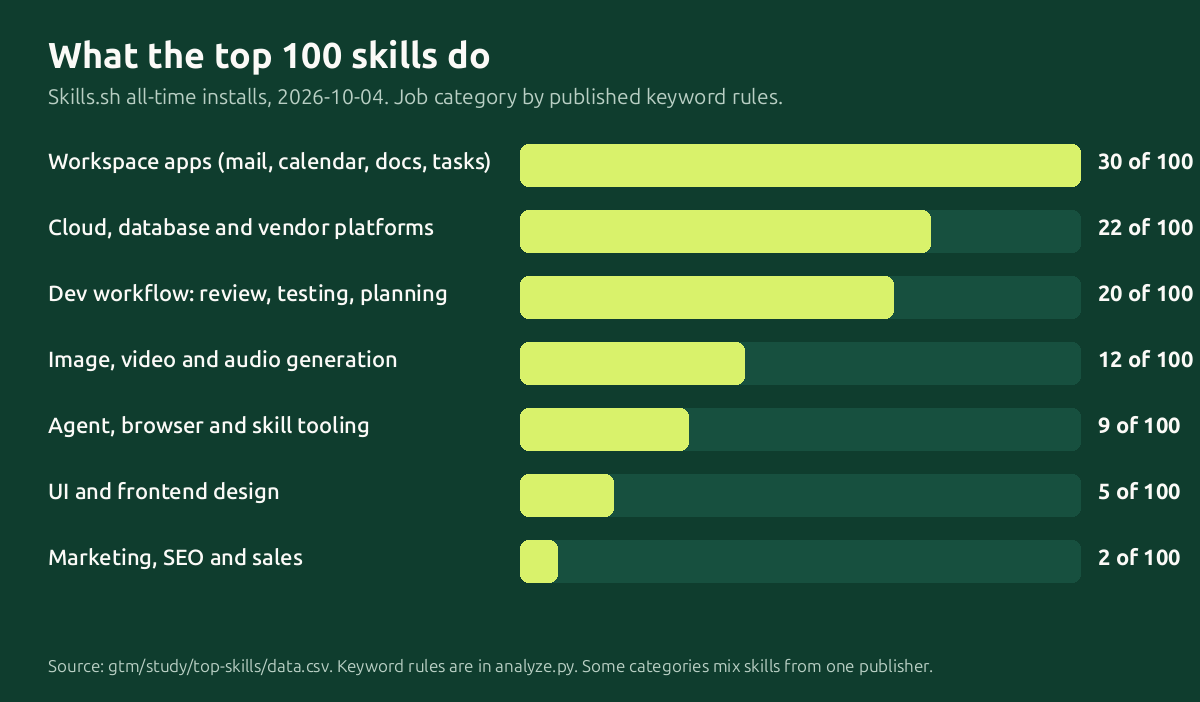
- Most of the top 100 are connectors and developer tools. 30 are workspace apps, 22 cloud and vendor platforms, 20 dev workflow (review, testing, planning), 12 image, video and audio generation, 9 agent and browser tooling, 5 UI design, 2 marketing and sales.
- Developer-facing 56, business-facing 32, creative 12. Of the 32 business-facing, 30 are workspace apps. Marketing and sales is 2 of 100.
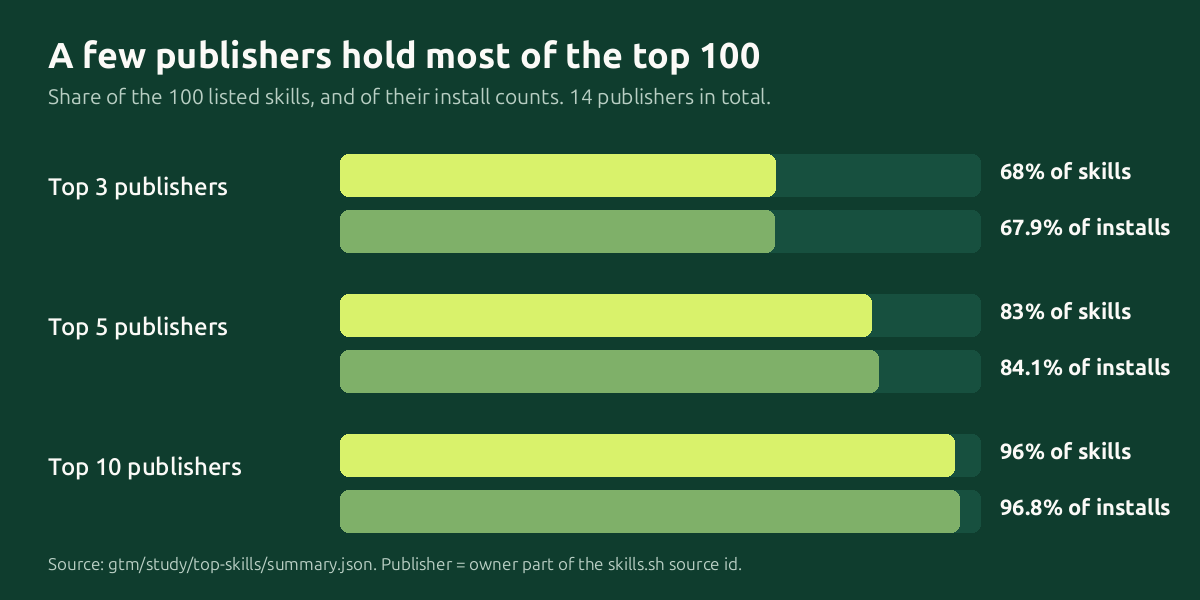
- A few publishers hold most of the list. 14 publishers in total. The top 3 hold 68 skills and 67.9% of the install counts, the top 5 hold 83 skills and 84.1%, and the top 10 hold 96 skills and 96.8%. Two of the identifiers belong to one vendor family; counted together, the top 3 hold 71 skills and 69.9%.
- The head is steep, the body is flat. Rank 1 has 3,692,279 installs and rank 100 has 460,312, a ratio of 8.0. But 80 of the 100 sit between 500,000 and 1,000,000, the median is 654,433, only 6 are over 1 million and 14 are at or under 500,000. The top 10 hold 18.1% of all installs, the top 20 hold 29.0%, the top 50 hold 59.7%.
- Skills are short. Median length 108 lines. Of 71: 12 up to 50 lines, 22 of 51 to 100, 23 of 101 to 200, 12 of 201 to 500, 2 over 500 (longest 1,206).
- Descriptions are mid-length, and 29 of 71 never say when to use the skill. Median 368 characters. 11 up to 150, 19 of 151 to 300, 14 of 301 to 500, 27 of 501 to 1,024, none over 1,024. 42 of 71 contain a "when to use" phrase.
- Most are plain text. 14 of 71 bundle scripts. By language (a skill can have several): shell 7, PowerShell 7, JavaScript 5, Python 4, TypeScript 1.
Limits
- The leaderboard counts installs per package, and a package installs many skills at once, so one publisher's skills tend to share a number. Read counts as weight on the list, not as separate users.
- A keyword classifier is crude. A skill can fit two categories, the rules are ours, and changing them moves counts. Fix: they are published, and
data.csvhas the category for every skill. - Only the top 100 is covered. The leaderboard keeps going below rank 100, so this says nothing about mid-sized skills.
- 29 skills could not be read (see Sample). The 24 with a vendor domain as source are all workspace connectors, so the file measures understate that group.
- One snapshot on one day. Install counts change.
Gaps we see, for skill authors
These are reads of the list, not a market study.
- Business jobs outside one vendor's workspace connectors are almost absent. Of the 32 business-facing skills, 30 are connectors for one family of apps. Marketing and sales is 2 of 100. We read the 100 names and found none about finance, legal, HR or customer support. They may be popular below rank 100. We did not measure that.
- Finished documents are under-served. The list is mostly tools that act (call an API, deploy, generate media) and rules for building software. In our reading of the names, none produces a business document someone sends, such as a quote, a case study or a postmortem.
- Say when to use it. 29 of 71 descriptions have no "use when" phrase. A skill that names its trigger is easier for an assistant to pick, and for a person to judge.
- Write for assistants without your tools. 14 of 71 bundle code, and 7 of them include PowerShell. A skill that depends on one runtime should say what to do on another, or without code at all.
- Short is normal. 57 of 71 are 200 lines or fewer. If yours is long, move reference material into linked files.
Reproduce
python3 fetch.py && python3 resolve.py && python3 analyze.py && python3 charts.py. Needs curl and Python 3. The fetched raw/ files are not kept in the repo.
We make portable skills with a paste-in prompt for every one. The free ones are at https://github.com/proskillpacks/skills
Files
data.csv summary.json fetch_log.csv fetch.py resolve.py analyze.py charts.py
Follow for new free skills
New free skills and guides appear in all of these as we publish them. Pick whichever you already use.
- RSS feed for any feed reader
- Watch the free skills repo on GitHub
- Follow on Gumroad