
A weekly check-in can fit in 30 minutes: how are you, their topics first, priorities and blockers, one topic of yours, then agree what happens next.
16 questions you can copy
A 30 minute agenda for a weekly one on one, and six other versions: a 15 minute check-in, a remote one, one for a difficult week, one before a review, one after a project, and a note to send afterwards.
Jump to: The 30 minute agendaOther versions of the agenda
The 30 minutes, step by step
- 0-5 minHow has this week been for you?
- 5-15 minWhat is the one thing you most want to talk about?
- 15-22 minWhat are your top three priorities this week?
- 15-22 minWhat is stuck, and what is it stuck on?
- 22-27 minMy one topic: [ONE TOPIC THAT MATTERS. ONLY ONE.]
- 27-30 minSo I will [MY ACTION] by [DATE] and you will [THEIR ACTION] by [DATE]. Right?
Feedback for you
- What is one thing I could do differently to help you?
- Is there anything I do that makes your work harder?
Team and relationships
- How is it working between you and [COLLEAGUE OR TEAM]?
Decisions and ownership
- Which decisions would you like to make on your own?
More examples, by situation
Other versions of the agenda
- 15 minutes0-3: How are you? 3-8: Your top two priorities. 8-12: One thing that is stuck. 12-15: What we each do before next time.
- For remote workers0-5: How is the week, and how is the setup (tools, hours, quiet)? 5-15: Your priorities. 15-22: What do you need from the team? 22-27: Anything you miss, or want less of? 27-30: Actions.
- For a hard week0-5: Say how you are, not only how the work is. 5-15: What is too much, and what could wait? 15-25: What can I take off you or move? 25-30: What we agree, and when we talk again.
- Before a review0-10: Your own view of the period: two things that went well, one that did not. 10-20: My examples and where they differ from yours. 20-30: Goals and what you need for the next period.
- After a project0-10: What worked? 10-20: What would we change? 20-25: Who should hear about this? 25-30: What we take to the next project.
- A note to send afterwardsThanks for today. What we agreed: I will [MY ACTION] by [DATE]. You will [THEIR ACTION] by [DATE]. Next time we cover: [TOPIC]. Please tell me if I missed anything.
Download these examples
The same text as this page, in one file, with the gaps ready to fill in.
How to use these
- Start with how they are. Then let them pick what to talk about first.
- Bring one topic of your own, not five. Say the facts first.
- Say out loud what you both agreed, write it on a note sheet, and send a short follow-up the same day.
What to avoid
- Bring one topic, not five. Decide before you go in: if we only cover one thing, which one?
- Write only facts and agreements. Your employer may keep these notes and the person may ask to see them.
- No guesses about personality, health, family or private life.
Official pages. Not legal or HR advice. If a one-to-one touches a complaint, a warning, discrimination, health or a safety matter, stop, listen, say you will speak to HR and follow your employer's procedure.
- Acas: Reviews and appraisals (what a review is for), read 5 October 2026
- EEOC: Prohibited employment policies and practices (pointer only, for US readers), read 5 October 2026
UK readers: the free Acas helpline is on its contact page. US readers: see the EEOC page and your employer's HR team.
New tools and free samples by email. A few a month. Unsubscribe any time.
FollowHandled by Gumroad. See our privacy page.
What the full kit adds
This page shows 10 of them. The kit has the rest, and the files you fill in.
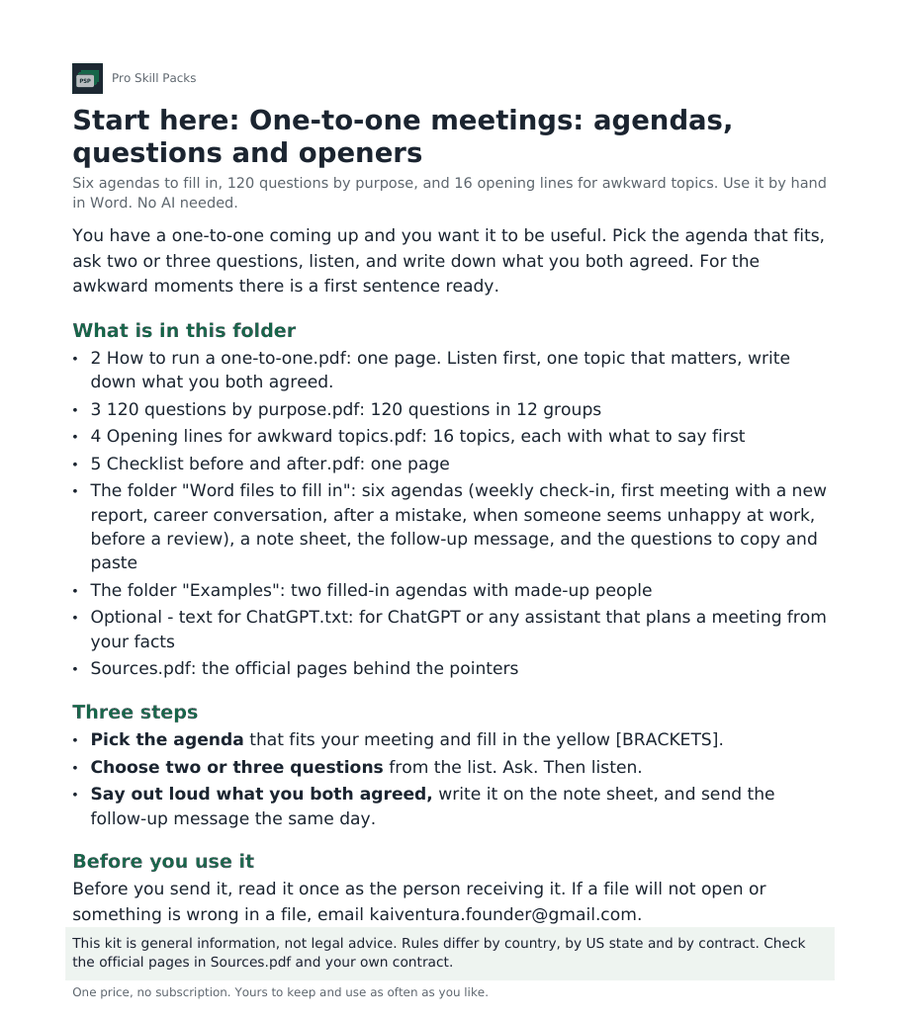
One-to-one meetings: agendas, questions and openers
Run a useful one-to-one meeting with someone you manage.
- Who it is for
- Managers who hold regular one-to-ones.
- What you give it
- An agenda and the questions that fit.
- What you get back
- Six agendas, 120 questions, 16 openers for awkward topics and a follow-up message.
Word files you fill in by hand.
Filled in by hand on 2 example cases before release. How we test.
What is in it
- All 120 questions in 12 groups by purpose (this page shows 10)
- 6 agendas to fill in (Word) and a note sheet
- 16 opening lines for awkward topics, the follow-up message and a one-page guide
- 2 finished examples, including a one-to-one after a public mistake
$9, one price, no subscription. 30-day refund. Works with no AI.
The full kit goes on sale on 6 October. Follow on Gumroad to hear when it is out.
What should be on a one on one agenda?
A few minutes for them to start, their priorities, anything stuck, feedback both ways, one topic of yours, and agreed actions. Let the employee choose the first topic.
Who should write the agenda for a one on one?
Share it. Keep a shared note where both of you add topics before the meeting. The employee's items come first.
How long should a one on one agenda be?
A few items. Leave room for the other person to add theirs. A full agenda leaves no time to talk.
What is the difference between an agenda and a list of questions?
An agenda says what you will cover in this meeting, in order. A list of questions is a pool to pick from. Use the list to build the agenda.
Questions people ask
How long should a one-to-one be?
The agenda here is a 30-minute weekly check-in. The kit has six agendas, and some run longer: the first meeting with a new report is 60 minutes.
Whose topics come first?
Theirs. After the opening, the next ten minutes are for the one thing they most want to talk about. Your own topic comes later, and there is only one.
What should I write down?
Only facts and agreements: what you will do, what they will do and by when. Your employer may keep these notes and the person may ask to see them.
Is this legal or HR advice?
No. It is general wording. If a conversation turns into a complaint, a warning, discrimination, health or anything formal, stop and speak to HR first. In the UK, Acas explains the steps.
More
- One on one meeting questions for managers: 24 to ask, by purpose (2026)
- First one on one with a new employee: 16 questions to ask, by purpose (2026)
- All the words for managing people
- Free: 20 opening lines for hard conversations
General wording, not legal or HR advice. For anything formal, speak to HR. In the UK, Acas explains the steps. Official pages read 5 October 2026.
Sources
- Acas: Reviews and appraisals, read 5 October 2026
- EEOC: Prohibited employment policies and practices, read 5 October 2026
- Acas explains the steps, read 5 October 2026