5 questions you can copy
Private, with the facts first. Questions that find out what happened without blame, and three opening lines: a mistake in public, work below standard and a missed deadline.
Questions about a mistake
- What happened, in your own words?
- What did you notice at the time?
- What would you do differently next time?
- What do you need in order to put it right?
- What help do you want from me?
Three ways to open
- I want to talk about what happened in [MEETING OR EMAIL]. First: how are you?
- I looked at [PIECE OF WORK]. I want to show you what I saw, and hear what you think.
- The [TASK] was due on [DATE] and it came on [DATE]. I want to understand what happened.
How to use these
- Do it in private. Open with one of the lines below and say the facts first.
- Ask the questions one at a time. Listen to the end.
- Agree what happens next, and write it down.
What to avoid
- Do not bring it up again unless it happens again.
- If someone criticised them in front of others, speak to that person separately.
- The mistake may be serious, may break a rule or the law, may involve a complaint, or may lead to a formal warning. Check your employer's procedure and speak to HR before you meet.
- Do not repeat the criticism in front of others. Do this in private.
Official pages. Not legal or HR advice. If a one-to-one touches a complaint, a warning, discrimination, health or a safety matter, stop, listen, say you will speak to HR and follow your employer's procedure.
- Acas: Problems with an employee's performance (how employers should handle performance and conduct problems), read 5 October 2026
- Acas: contact and helpline (free advice) (free advice), read 5 October 2026
- EEOC: Prohibited employment policies and practices (pointer only, for US readers), read 5 October 2026
UK readers: the free Acas helpline is on its contact page. US readers: see the EEOC page and your employer's HR team.
What the full kit adds
This page shows 5 of them. The kit has the rest, and the files you fill in.
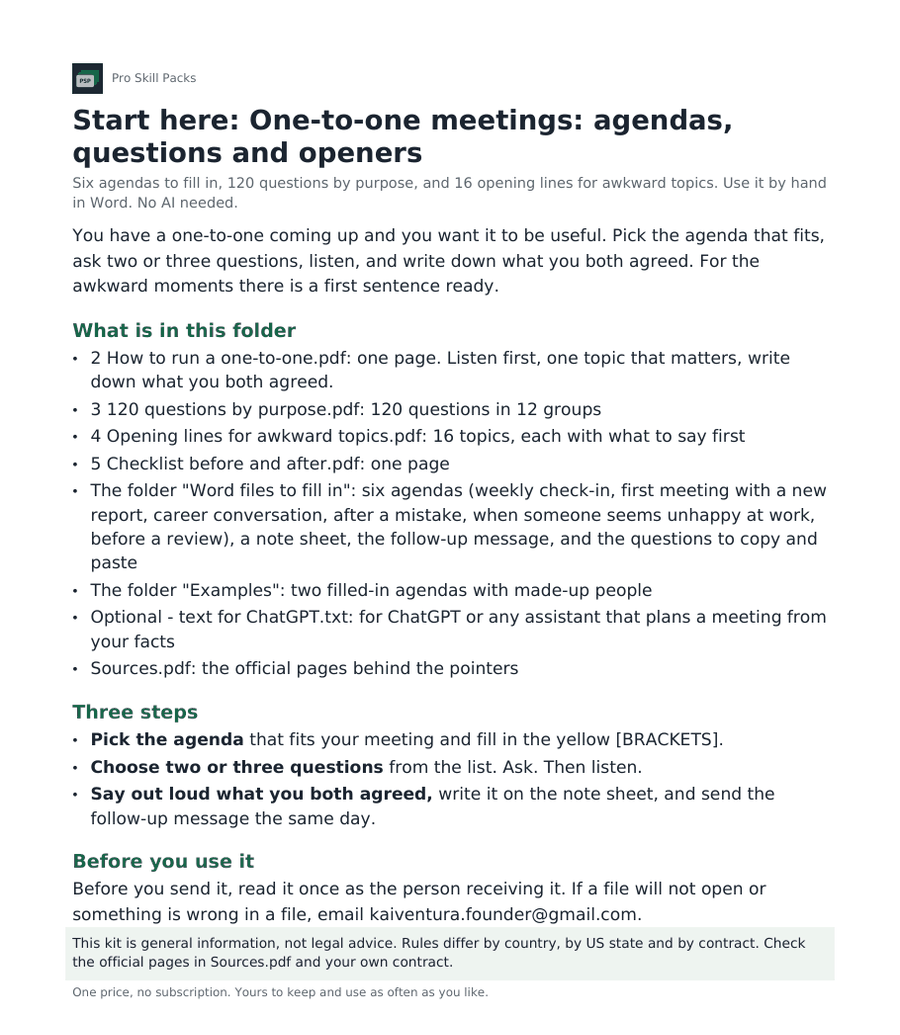
One-to-one meetings: agendas, questions and openers
Six agendas to fill in, 120 questions by purpose and 16 opening lines for awkward topics, with a note sheet and a follow-up message.
What is in it
- All 120 questions in 12 groups by purpose (this page shows 5)
- 6 agendas to fill in (Word) and a note sheet
- 16 opening lines for awkward topics, the follow-up message and a one-page guide
- 2 finished examples, including a one-to-one after a public mistake
$9, one price, no subscription. 30-day refund. Works with no AI.
Questions people ask
Should I talk to them in private?
Yes. Do not repeat the criticism in front of others.
What if the mistake is serious?
It may break a rule or the law, involve a complaint or lead to a formal warning. Check your employer's procedure and speak to HR before you meet. In the UK, Acas explains how employers should handle performance and conduct problems.
What do I say first?
Start with the person, then the facts: "I want to talk about what happened in [MEETING OR EMAIL]. First: how are you?"
Is this legal or HR advice?
No. It is general wording. If a conversation turns into a complaint, a warning, discrimination, health or anything formal, stop and speak to HR first. In the UK, Acas explains the steps.
More
- One on one meeting questions for managers: 10 to start with
- One on one meeting agenda: a 30 minute weekly check-in
- All the words for managing people
- Free: 20 opening lines for hard conversations
General wording, not legal or HR advice. For anything formal, speak to HR. In the UK, Acas explains the steps. Official pages read 5 October 2026.