
To ask for a reference, ask someone who knows your work, ask before you list them, say what job it is for, make it easy to say no, and send them what they need.
4 messages you can copy
Four messages for four situations. Each one makes it easy for the other person to say yes or no. Replace every [BRACKET] with a real fact.
- A former managerSubject: Could you be a reference for me?Hi [NAME], I hope you are well. I am applying for [TYPE OF JOB] roles. Would you be willing to be a reference for me? You saw my work on [PROJECT OR PERIOD], so you know it well. I can send my resume and the job description. An employer may call you in about [MONTH]. It is fine to say no. Thank you, [YOUR NAME]
- A colleague or clientSubject: A favour: could you be a reference?Hi [NAME], We worked together on [PROJECT]. I am applying for [TYPE OF JOB] roles, and I would be grateful if you could speak about [WHAT THEY SAW, FOR EXAMPLE HOW I HANDLED THE DEADLINE]. Would you be happy to? If you are too busy, I understand. Thank you, [YOUR NAME]
- Someone you have not spoken to for yearsSubject: Hello from [COMPANY]Hi [NAME], It has been a while since we worked together at [COMPANY]. I hope all is well with you. I am applying for [TYPE OF JOB] roles and would value you as a reference. To jog your memory, we worked on [TWO THINGS]. Would you be open to it? A no is fine. [YOUR NAME]
- After they said yesSubject: Thank you, and the detailsHi [NAME], Thank you for agreeing. [EMPLOYER] may contact you about [JOB TITLE] by [DATE]. I have attached the job description and my resume. Three things that may help: [POINT 1], [POINT 2], [POINT 3]. I will tell you as soon as I hear back, whatever the result. [YOUR NAME]
What to avoid
- Do not list someone as a reference before you ask. They should never be surprised by a call.
- Do not ask for a "glowing" reference. Ask whether they can speak about your work.
- Do not ask someone who barely knows your work. A short, specific reference beats a long, vague one.
- Do not forget the details: the job, the date and your resume. Make it easy.
- Tell them how it went afterwards, and thank them again.
New free pages by email. A few a month. Unsubscribe any time.
FollowHandled by Gumroad. See our privacy page.
What the paid kit adds
The messages above are free. The kit is for the harder situation: a gap, a layoff or leaving under a cloud.
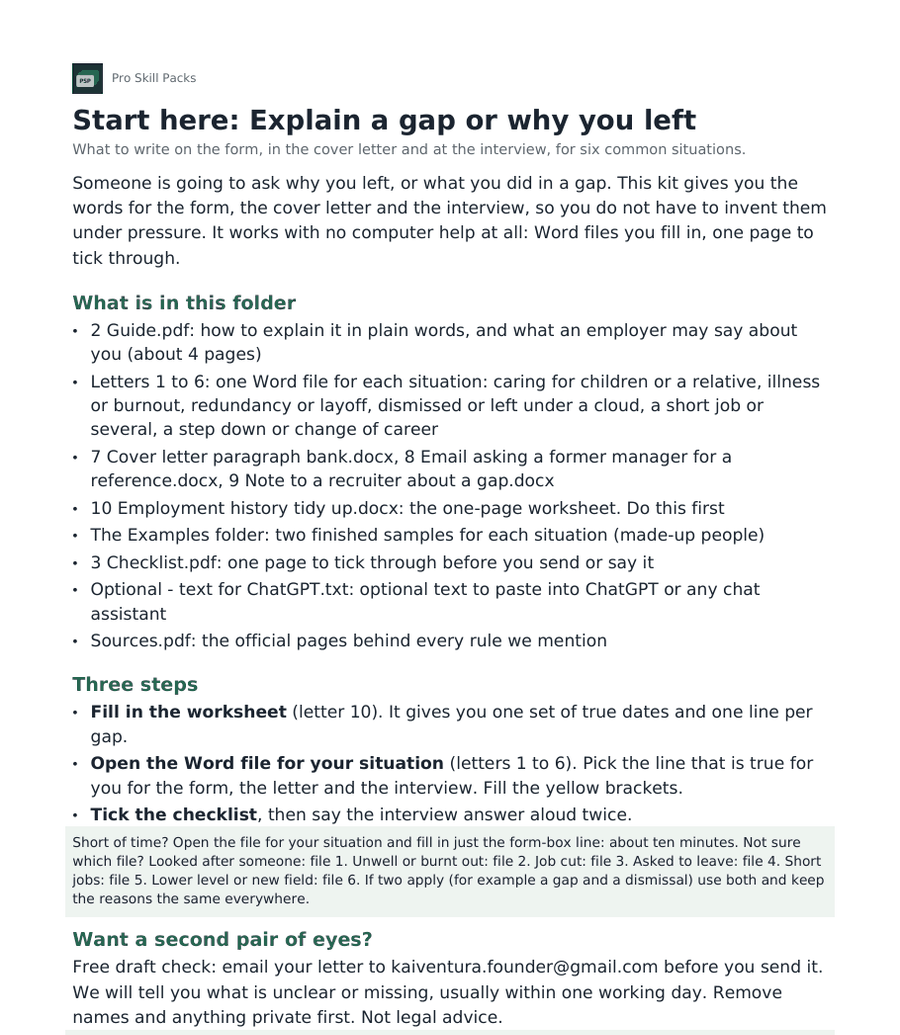
Explain a gap or why you left
What to say on the form, in your cover letter and in the interview for six situations: caring for someone, illness, layoff, dismissal, short jobs and a career change. It also has an email asking a former manager for a reference, in three versions. Read the free guide first.
Questions people ask
Who should I ask?
A former manager is best. A senior colleague or a client who saw your work also works. Pick someone who can give a real example.
How early should I ask?
Before you apply, or as soon as you reach the later stages. Give them a date, and a week or two to reply.
What if my old manager has left?
Ask a colleague who worked with you, or the manager's own manager. Say who you ask and why.
Do I have to give a reference from my current employer?
No. Many people give them only after an offer, and say so. You can say "I would rather my current employer is asked after an offer".
What if someone says no?
Thank them and ask someone else. It is not personal. They may be busy or not allowed to give one.