
Performance review phrases for communication should say what the person did and give one real example. The phrases below do this at three levels, matched to the rating.
| Rating | Tone |
|---|---|
| Exceeds what the role needs | Specific and warm. Name the result of the good communication. |
| Meets what the role needs | Plain and fair. Say what works and keep the example. |
| Below what the role needs | About the behaviour, not the person. Say what you would like instead. |
24 phrases you can copy
Twenty-four phrases for communication at three levels: 12 by rating, and 12 more by situation. Each one has a gap for a real example. Rewrite the wording to sound like you.
Jump to: By ratingIn writingIn meetingsWith customers and other teams
Exceeds what the role needs
- Explains complicated matters in plain words: for example, [TOPIC AND WHO THEY EXPLAINED IT TO].
- Writes emails that need no follow-up questions: for example, [THE EMAIL OR DOCUMENT].
- Listens fully before responding and asks good questions: for example, [THE CONVERSATION].
- Adjusts how they speak to suit the listener: for example, [THE AUDIENCE].
Meets what the role needs
- Writes clearly and to the point: for example, [MESSAGE OR DOCUMENT].
- Replies to messages within the usual time: for example, [TYPE OF MESSAGE].
- Gives updates in meetings that the team can follow: for example, [MEETING].
- Asks questions when something is unclear: for example, [THE QUESTION].
Below what the role needs
- Messages are often long or unclear, so readers need to ask follow-up questions: for example, [THE MESSAGE].
- Important information did not reach [WHO]: for example, [WHAT AND WHEN].
- Says little in meetings, even when they have useful views. I would like to hear more of them: for example, [TOPIC].
- Some messages have come across as sharper than intended: for example, [THE MESSAGE AND HOW IT WAS READ].
More examples, by situation
In writing
- ExceedsWrites updates the reader can act on straight away, with the decision needed in the first line: for example, [UPDATE AND WHO ACTED ON IT].
- MeetsKeeps written messages short and checks names, dates and numbers before sending: for example, [MESSAGE OR REPORT].
- BelowMessages often leave out the date, the owner or the next step, so the reader has to ask: for example, [MESSAGE AND WHAT WAS MISSING].
- BelowSends long messages with the main point near the end. I would like the point to come first: for example, [MESSAGE].
In meetings
- ExceedsSums up the decisions and the owners at the end of a meeting and sends the notes the same day: for example, [MEETING].
- MeetsPrepares for meetings and speaks to the point when it is their turn: for example, [MEETING].
- BelowOften joins meetings without the information they need, which slows the team down: for example, [MEETING AND WHAT WAS MISSING].
- BelowStarts speaking before others have finished. I would like each person to finish first: for example, [MEETING].
With customers and other teams
- ExceedsTells customers about a delay early and plainly, with a new date: for example, [CUSTOMER AND SITUATION].
- MeetsAnswers requests from other teams within the time they agreed: for example, [REQUEST].
- BelowCustomers have had to chase for answers on [TOPIC]. I would like replies within [AGREED TIME]: for example, [CASE].
- BelowHands work to other teams without enough notes, so they have to ask what was done: for example, [HANDOVER].
Download these examples
The same text as this page, in one file, with the gaps ready to fill in.
How to use these
- Pick the phrase that matches what you saw.
- Replace every [BRACKET] with a real fact: a date, a number or the name of the piece of work.
- If you cannot think of an example, leave the phrase out.
- Read the finished review once as the person who will receive it.
What to avoid
- Do not write a label about the person, such as "negative attitude". Write what happened instead: "In [MEETING ON DATE] they said [WHAT], and [WHAT HAPPENED NEXT]."
- If a point is new to them, tell them in person before the written review.
- Do not write the reason for any absence. Ask HR before you mention absence at all.
The law in many places protects people from unfair treatment linked to things like age, disability, sex, race, religion or belief, sexual orientation, pregnancy and maternity. Do not mention these in a review, and do not guess at them.
Official pages. Not legal or HR advice. If a formal step, a warning, a pay dispute or a complaint is involved, stop and speak to HR first.
- Acas: Reviews and appraisals (what a review is for), read 5 October 2026
- EEOC: Prohibited employment policies and practices (pointer only, for US readers), read 5 October 2026
UK readers: the free Acas helpline is on its contact page. US readers: see the EEOC page and your employer's HR team.
New tools and free samples by email. A few a month. Unsubscribe any time.
FollowHandled by Gumroad. See our privacy page.
What the full kit adds
This page shows 12 of them. The kit has the rest, and the files you fill in.
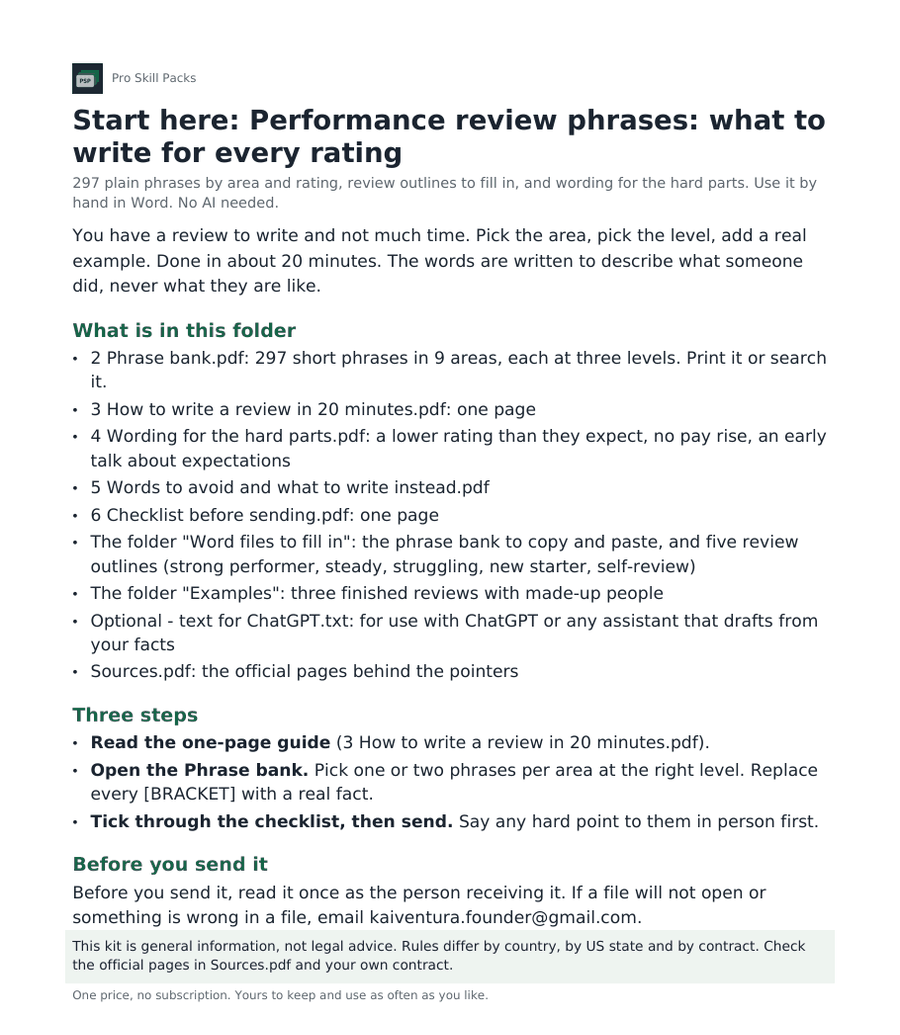
Performance review phrases: what to write for every rating
Write a fair performance review with plain, ready phrases.
- Who it is for
- Managers who write staff reviews.
- What you give it
- Phrases by area and rating, and fill in your examples.
- What you get back
- 297 phrases, five review outlines and wording for the hard parts.
Word files you fill in by hand.
Filled in by hand on 2 example cases before release. How we test.
What is in it
- All 297 phrases: 9 areas at 3 levels each (this page shows 12 of them)
- 5 review outlines in Word (strong, steady, struggling, new starter, self-review) and 3 finished examples
- Wording for the hard parts: a rating lower than expected, no pay rise, an early talk about expectations
- Words to avoid, with what to write instead, and a 16-point checklist before sending
$9, one price, no subscription. 30-day refund. Works with no AI.
The full kit goes on sale on 6 October. Follow on Gumroad to hear when it is out.
How do I write a performance review comment about communication?
Pick one thing you saw, such as an update, a meeting or a customer message. Say what the person did, what happened as a result, and what you would like next. Use a date or the name of the piece of work.
What are examples of performance review phrases for communication?
A clear one says the person explains a task so others can act on it. Another says they share bad news early. The phrases above are grouped by rating, so pick the one that matches what you saw.
How can performance review phrases improve communication?
A phrase helps only when it names what you saw. "Sends a short update every Friday" tells the person what to keep doing. "Poor communicator" tells them nothing. Add one real example from the period to each phrase.
Questions people ask
Do I need an example for every communication comment?
Every rating should have at least one real example with a date, a number or the name of the work. That is one of the checks in the kit's checklist.
What do I do with the [BRACKETS]?
Replace each one with a real fact: a date, a number or the name of the piece of work. If you cannot think of an example, leave the phrase out.
How many phrases are in the full kit?
297, in nine areas at three levels each. This page shows only a few of them.
Is this legal or HR advice?
No. It is general wording. If a formal step, a warning, a pay dispute or a complaint is involved, stop and speak to HR first. In the UK, Acas explains the steps.
More
- Performance review comments for teamwork: 24 examples by rating and situation (2026)
- Performance review phrases for quality of work: 24 examples by rating and situation (2026)
- All the words for managing people
- Free: 20 opening lines for hard conversations
General wording, not legal or HR advice. For anything formal, speak to HR. In the UK, Acas explains the steps. Official pages read 5 October 2026.
Sources
- Acas: Reviews and appraisals, read 5 October 2026
- EEOC: Prohibited employment policies and practices, read 5 October 2026
- Acas explains the steps, read 5 October 2026