
12 phrases you can copy
Plain phrases for accuracy, care and standards, with a place for a real example.
Exceeds what the role needs
- Work is accurate and complete the first time: for example, [THE REPORT OR TASK].
- Checks their own work before handing it over, so very little comes back for correction: for example, [PIECE OF WORK].
- Sets a standard others copy: for example, [WHAT THE TEAM NOW DOES BECAUSE OF THEM].
- Notices details others miss: for example, [THE ERROR OR GAP THEY CAUGHT].
Meets what the role needs
- Work is accurate and needs only the usual checking: for example, [THE TASK].
- Follows the agreed steps and standards on each task: for example, [THE STANDARD].
- Completes tasks in full and notices when something is missing: for example, [WHAT THEY NOTICED].
- Corrects errors quickly once they are pointed out: for example, [THE ERROR AND THE FIX].
Below what the role needs
- Some work needed correcting before it could be used: for example, [WHAT WAS CORRECTED AND HOW OFTEN].
- Errors reached [THE CUSTOMER OR THE NEXT TEAM] on [NUMBER] occasions: for example, [THE CASE].
- The finished work often differs from what was asked: for example, [THE REQUEST AND WHAT CAME BACK].
- Checking is not yet a habit: for example, [AN ERROR A QUICK READ WOULD HAVE CAUGHT].
How to use these
- Pick the phrase that matches what you saw.
- Replace every [BRACKET] with a real fact: a date, a number or the name of the piece of work.
- If you cannot think of an example, leave the phrase out.
- Read the finished review once as the person who will receive it.
What to avoid
- Do not write "sloppy". Write: "[NUMBER] errors in [DOCUMENT] that were found by [WHO]."
- Do not write "always" or "never". Count it: "[NUMBER] times in [PERIOD]."
- Check records, not memory. The last few weeks always feel biggest.
The law in many places protects people from unfair treatment linked to things like age, disability, sex, race, religion or belief, sexual orientation, pregnancy and maternity. Do not mention these in a review, and do not guess at them.
Official pages. Not legal or HR advice. If a formal step, a warning, a pay dispute or a complaint is involved, stop and speak to HR first.
- Acas: Reviews and appraisals (what a review is for), read 5 October 2026
- EEOC: Prohibited employment policies and practices (pointer only, for US readers), read 5 October 2026
UK readers: the free Acas helpline is on its contact page. US readers: see the EEOC page and your employer's HR team.
What the full kit adds
This page shows 12 of them. The kit has the rest, and the files you fill in.
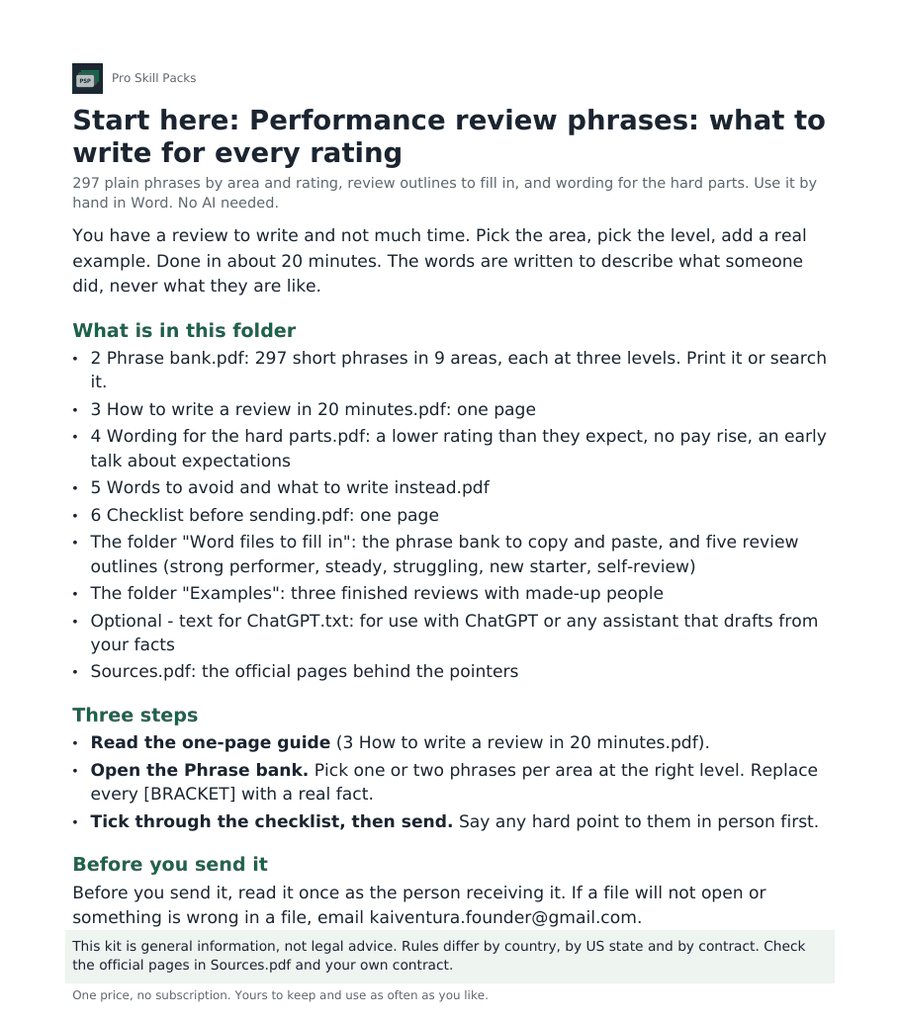
Performance review phrases: what to write for every rating
297 plain phrases for a review, at three levels, with five outlines to fill in and wording for the hard parts. Each phrase has a gap for a real example.
What is in it
- All 297 phrases: 9 areas at 3 levels each (this page shows 12 of them)
- 5 review outlines in Word (strong, steady, struggling, new starter, self-review) and 3 finished examples
- Wording for the hard parts: a rating lower than expected, no pay rise, an early talk about expectations
- Words to avoid, with what to write instead, and a 16-point checklist before sending
$9, one price, no subscription. 30-day refund. Works with no AI.
Questions people ask
How do I describe errors without a label?
Count them and name the work, for example "[NUMBER] errors in [DOCUMENT] that were found by [WHO]." That is what the kit suggests instead of a label such as "sloppy".
What do I do with the [BRACKETS]?
Replace each one with a real fact: a date, a number or the name of the piece of work. If you cannot think of an example, leave the phrase out.
How many phrases are in the full kit?
297, in nine areas at three levels each. This page shows only a few of them.
Is this legal or HR advice?
No. It is general wording. If a formal step, a warning, a pay dispute or a complaint is involved, stop and speak to HR first. In the UK, Acas explains the steps.
More
- Performance review phrases for communication: 12 examples by rating
- Performance review phrases for needs improvement: 12 fair ways to say it
- All the words for managing people
- Free: 20 opening lines for hard conversations
General wording, not legal or HR advice. For anything formal, speak to HR. In the UK, Acas explains the steps. Official pages read 5 October 2026.