
12 phrases you can copy
How to describe a gap as something you saw, with a date, instead of a label. One or two phrases for some of the nine areas.
Quality of work
- Some work needed correcting before it could be used: for example, [WHAT WAS CORRECTED AND HOW OFTEN].
- Errors reached [THE CUSTOMER OR THE NEXT TEAM] on [NUMBER] occasions: for example, [THE CASE].
Reliability
- Missed [NUMBER] deadlines in [PERIOD]: for example, [TASK AND DATE].
- Problems with deadlines were raised late, so there was little time to help: for example, [THE CASE].
Communication
- Messages are often long or unclear, so readers need to ask follow-up questions: for example, [THE MESSAGE].
- Important information did not reach [WHO]: for example, [WHAT AND WHEN].
Teamwork
- Tends to work alone, and the team has missed their input: for example, [PROJECT].
- Has not yet shared information that colleagues needed: for example, [WHAT AND WHEN].
Initiative
- Waits to be told what to do next: for example, [THE OCCASION].
- Raises problems but does not yet suggest a way forward: for example, [THE PROBLEM].
Problem solving
- Fixes the symptom but the same problem returns: for example, [THE PROBLEM].
- Asks for help only after a long time on a problem: for example, [THE ISSUE AND HOW LONG].
How to use these
- Pick the phrase that matches what you saw.
- Replace every [BRACKET] with a real fact: a date, a number or the name of the piece of work.
- If you cannot think of an example, leave the phrase out.
- Read the finished review once as the person who will receive it.
What to avoid
- Keep to no more than three things to improve, and say what would change each one.
- Nothing in the review should be a surprise. If a point is new to them, tell them in a one-to-one first.
- Do not promise a pay rise, a promotion or a rating change that you cannot give.
- Do not write the reason for any absence. Describe the work only.
The law in many places protects people from unfair treatment linked to things like age, disability, sex, race, religion or belief, sexual orientation, pregnancy and maternity. Do not mention these in a review, and do not guess at them.
Official pages. Not legal or HR advice. If a formal step, a warning, a pay dispute or a complaint is involved, stop and speak to HR first.
- Acas: Reviews and appraisals (what a review is for), read 5 October 2026
- Acas: Problems with an employee's performance (how employers should handle performance and conduct problems), read 5 October 2026
- EEOC: Prohibited employment policies and practices (pointer only, for US readers), read 5 October 2026
UK readers: the free Acas helpline is on its contact page. US readers: see the EEOC page and your employer's HR team.
What the full kit adds
This page shows 12 of them. The kit has the rest, and the files you fill in.
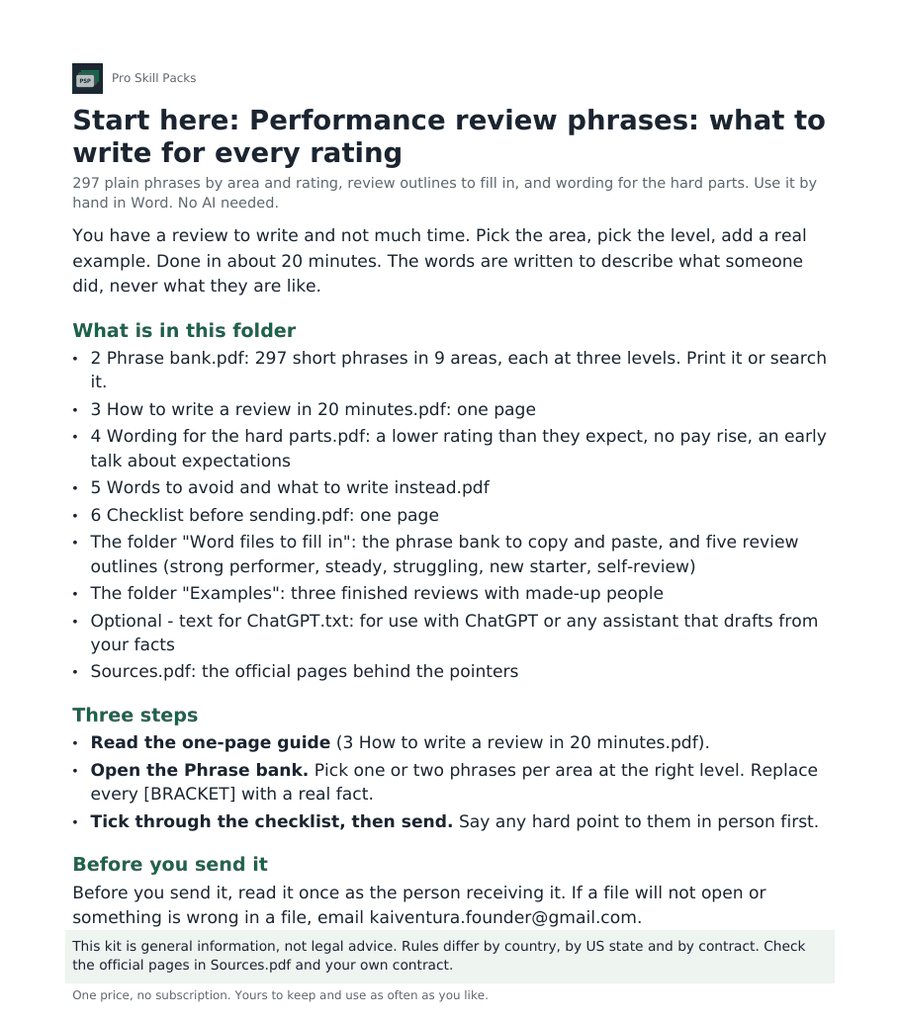
Performance review phrases: what to write for every rating
297 plain phrases for a review, at three levels, with five outlines to fill in and wording for the hard parts. Each phrase has a gap for a real example.
What is in it
- All 297 phrases: 9 areas at 3 levels each (this page shows 12 of them)
- 5 review outlines in Word (strong, steady, struggling, new starter, self-review) and 3 finished examples
- Wording for the hard parts: a rating lower than expected, no pay rise, an early talk about expectations
- Words to avoid, with what to write instead, and a 16-point checklist before sending
$9, one price, no subscription. 30-day refund. Works with no AI.
Questions people ask
How many things should I say need improving?
No more than three, and each should say what would change it. That is one of the checks in the kit's checklist.
Should the person already know what is in the review?
Yes. A review should confirm what they already know. If a point is new to them, tell them in a one-to-one first.
What do I do with the [BRACKETS]?
Replace each one with a real fact: a date, a number or the name of the piece of work. If you cannot think of an example, leave the phrase out.
Is this legal or HR advice?
No. It is general wording. If a formal step, a warning, a pay dispute or a complaint is involved, stop and speak to HR first. In the UK, Acas explains the steps.
More
- Performance review phrases for quality of work: 12 examples by rating
- How to write a performance review in 20 minutes
- All the words for managing people
- Free: 20 opening lines for hard conversations
General wording, not legal or HR advice. For anything formal, speak to HR. In the UK, Acas explains the steps. Official pages read 5 October 2026.