
9 phrases you can copy
The five steps written out in full, plus one 'meets' phrase from each of the nine areas as a starter set, and six lines from the checklist. Say it before you write it, so nothing in the review is a surprise.
One phrase from each of the nine areas
- Quality of workWork is accurate and needs only the usual checking: for example, [THE TASK].
- ReliabilityMeets most deadlines and says so when one will slip: for example, [TASK].
- CommunicationWrites clearly and to the point: for example, [MESSAGE OR DOCUMENT].
- TeamworkWorks well with the team day to day: for example, [A RECENT PIECE OF TEAMWORK].
- InitiativeGets on with their tasks without close supervision: for example, [TASK].
- Problem solvingSolves routine problems without help: for example, [THE PROBLEM].
- Customer focusAnswers customers politely and accurately: for example, [THE CASE].
- Leading othersSets goals with the team and reviews them: [THE GOALS].
- Learning and growthLearns the new tasks asked of them in a reasonable time: for example, [THE TASK].
Check before you send
- Every rating has at least one real example with a date, a number or a name of the work.
- I checked the facts against records, emails or my notes, not only my memory.
- I looked at the whole period, not only the last few weeks.
- There are no more than three things to improve, and each says what would change it.
- Nothing in it will be a surprise: I have already said it, or I will say it in the meeting.
- I promised no pay rise, promotion or rating change that I cannot give.
How to use these
- Before you start (2 minutes): open last period's goals, your own notes, emails with praise or complaints, and any numbers for the role. Have your employer's form and rating scale to hand.
- Collect the facts (5 minutes): write down up to three things they did well and up to three to improve. Next to each, write a date, a number or the name of the piece of work. If you cannot find an example, say less.
- Choose the level for each area (3 minutes): decide whether it is above, at or below what the role needs.
- Build it (7 minutes): paste one or two phrases for each area and replace every [BRACKET] with a real fact. Delete what is not true. Keep to a page or two.
- Write the summary (2 minutes): three lines. How the period went overall, their biggest strength, and the one thing to focus on next.
- Check it (1 minute): run through the checklist, then read it once as the person who will receive it.
What to avoid
- Say it before you write it. If a point is new to them, tell them in a one-to-one first. A review should confirm what they already know.
- Check records, not memory. The last few weeks always feel biggest.
- Use your employer's form and rating scale if there is one.
The law in many places protects people from unfair treatment linked to things like age, disability, sex, race, religion or belief, sexual orientation, pregnancy and maternity. Do not mention these in a review, and do not guess at them.
Official pages. Not legal or HR advice. If a formal step, a warning, a pay dispute or a complaint is involved, stop and speak to HR first.
- Acas: Reviews and appraisals (what a review is for), read 5 October 2026
- EEOC: Prohibited employment policies and practices (pointer only, for US readers), read 5 October 2026
UK readers: the free Acas helpline is on its contact page. US readers: see the EEOC page and your employer's HR team.
What the full kit adds
This page shows 9 of them. The kit has the rest, and the files you fill in.
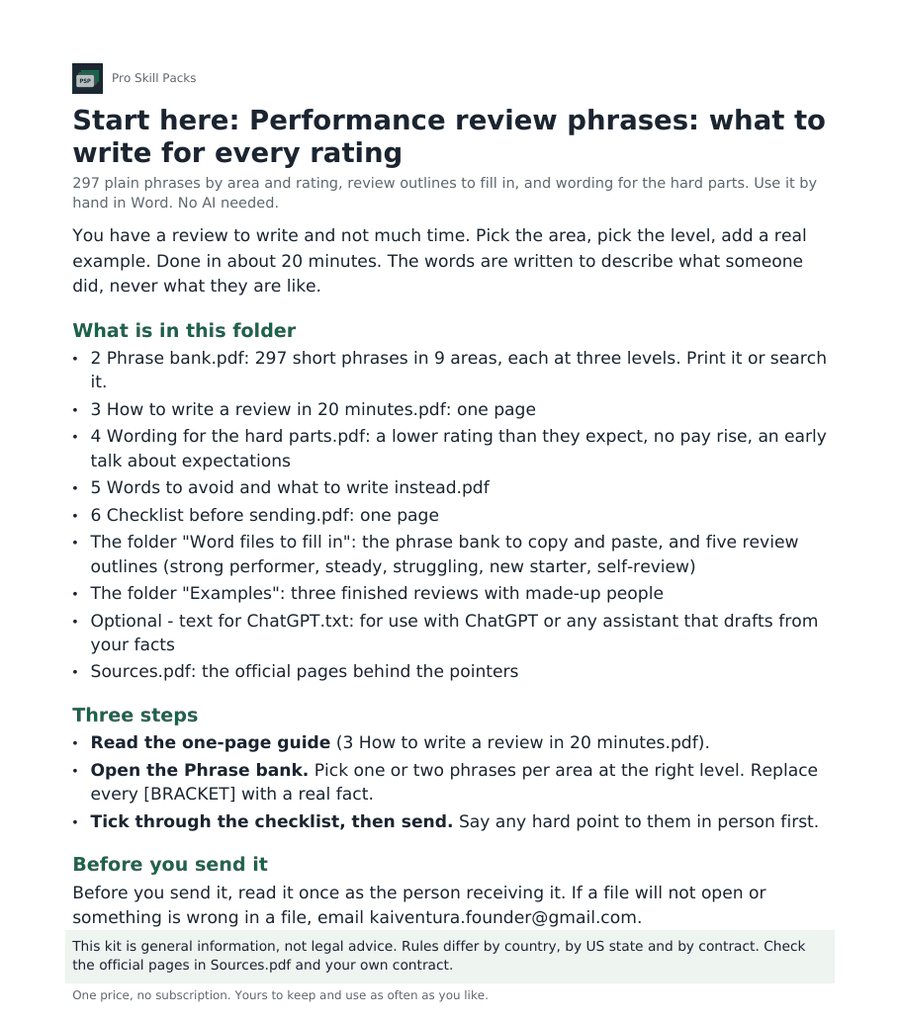
Performance review phrases: what to write for every rating
297 plain phrases for a review, at three levels, with five outlines to fill in and wording for the hard parts. Each phrase has a gap for a real example.
What is in it
- All 297 phrases: 9 areas at 3 levels each (this page shows 9 of them)
- 5 review outlines in Word (strong, steady, struggling, new starter, self-review) and 3 finished examples
- Wording for the hard parts: a rating lower than expected, no pay rise, an early talk about expectations
- Words to avoid, with what to write instead, and a 16-point checklist before sending
$9, one price, no subscription. 30-day refund. Works with no AI.
Questions people ask
How long does a review take to write?
About 20 minutes if you have your notes in front of you: 5 to collect the facts, 3 to choose the levels, 7 to build it, 2 for the summary and 1 to check.
Where do I find the facts?
Last period's goals, your own notes, emails with praise or complaints, and any numbers for the role. Check records, not memory.
What if I cannot think of an example?
Say less. If you cannot find an example, leave the phrase out.
Is this legal or HR advice?
No. It is general wording. If a formal step, a warning, a pay dispute or a complaint is involved, stop and speak to HR first. In the UK, Acas explains the steps.
More
- Performance review phrases for communication: 12 examples by rating
- Performance review phrases for needs improvement: 12 fair ways to say it
- All the words for managing people
- Free: 20 opening lines for hard conversations
General wording, not legal or HR advice. For anything formal, speak to HR. In the UK, Acas explains the steps. Official pages read 5 October 2026.