Performance review phrases for job knowledge say what the person knows, how well they apply it and whether they help others learn. Pick one example you saw, say what happened, and say what you would like next. Judge the work, not the person.
| Rating | Tone, and an example opener |
|---|---|
| Exceeds | Specific and warm: "Explains [TOPIC] clearly to others." |
| Meets | Plain and fair: "Knows [TOPIC] well enough to work alone." |
| Below | About the work, with a next step: "I would like more confidence in [TOPIC]." |
24 phrases you can copy
Twenty-four phrases about what the person knows, how they use it and whether they help others learn. Rewrite each so it sounds like you.
Jump to: Exceeds what the role needsMeets what the role needsBelow what the role needsBy situation: new hire, long-serving, changing role, remote
Exceeds what the role needs
- Knows [TOPIC] well and explains it plainly to colleagues: for example, [EXAMPLE].
- Keeps up with changes in [FIELD] and applies them to [WORK]: for example, [EXAMPLE].
- Finds the cause of problems with [SYSTEM] without help: for example, [EXAMPLE].
- Is the person others ask about [TOPIC]. [NAME OR TEAM] has [RESULT] because of that.
- Wrote down how [PROCESS] works so others can use it: [DOCUMENT].
- Trained [NAME] on [TOPIC], and they now do [TASK] alone.
More examples, by situation
Meets what the role needs
- Knows the main parts of [ROLE] and does them without close supervision: [EXAMPLE].
- Asks good questions when a topic is new: [EXAMPLE].
- Applies [PROCESS] correctly and checks their work before sending it: [EXAMPLE].
- Has learned [TOOL] well enough to do [TASK] alone.
- Knows when to ask for help and does so early: [EXAMPLE].
- Follows the written steps for [PROCESS] and flags where they do not match what happens.
Below what the role needs
- Needs more time with [TOPIC] before working alone. I would like us to agree a plan by [DATE].
- Has not yet learned [TOOL]. This slowed [TASK] on [DATE]. I would like [TRAINING OR TASK] by [DATE].
- Mixes up [TWO THINGS] on some tasks: [EXAMPLE]. A short guide may help.
- Asks for the same answer about [TOPIC] more than once. I would like them to write it down so it sticks.
- Does not yet explain [TOPIC] to others. I would like one short walk-through by [DATE].
- Is unsure about [AREA] and tends to wait for help. I would like them to try first and then ask.
By situation: new hire, long-serving, changing role, remote
- New hireNew to [ROLE]: has learned [TOPICS] in [NUMBER] weeks. The next topic is [TOPIC].
- Long in the roleLong in the role: strong on [TOPIC]. I would like them to learn [NEW TOPIC] this year.
- Changing roleChanging role: has picked up [TOPIC] quickly. The gap is [TOPIC].
- RemoteRemote: finds answers in the team's documents before asking, and adds to them: [EXAMPLE].
- Covering for someoneCovered for [NAME] on [TOPIC] and kept [WORK] on track: [EXAMPLE].
- A course or certificatePassed [CERTIFICATE / COURSE] on [DATE] and used it on [WORK].
Download these examples
The same text as this page, in one file, with the gaps ready to fill in.
How to use these
- Pick the phrase that matches what you saw.
- Replace every [BRACKET] with a real fact: a date, a number or the name of the piece of work.
- If you cannot think of an example, leave the phrase out.
- Read the finished review once as the person who will receive it.
What to avoid
- Rating knowledge from one bad day.
- Vague words ("good", "weak") with no example.
- Mixing in quality or attitude comments. Keep those on their own pages.
- Comments about age, background or health.
- A gap with no plan.
The law in many places protects people from unfair treatment linked to things like age, disability, sex, race, religion or belief, sexual orientation, pregnancy and maternity. Do not mention these in a review, and do not guess at them.
Official pages. Not legal or HR advice. If a formal step, a warning, a pay dispute or a complaint is involved, stop and speak to HR first.
- Acas: Reviews and appraisals (what a review is for), read 5 October 2026
- Acas: Problems with an employee's performance (how employers should handle performance and conduct problems), read 5 October 2026
- EEOC: Prohibited employment policies and practices (pointer only, for US readers), read 5 October 2026
UK readers: the free Acas helpline is on its contact page. US readers: see the EEOC page and your employer's HR team.
New free pages by email. A few a month. Unsubscribe any time.
FollowHandled by Gumroad. See our privacy page.
What the full kit adds
This page shows 6 of them. The kit has the rest, and the files you fill in.
Performance review phrases: what to write for every rating
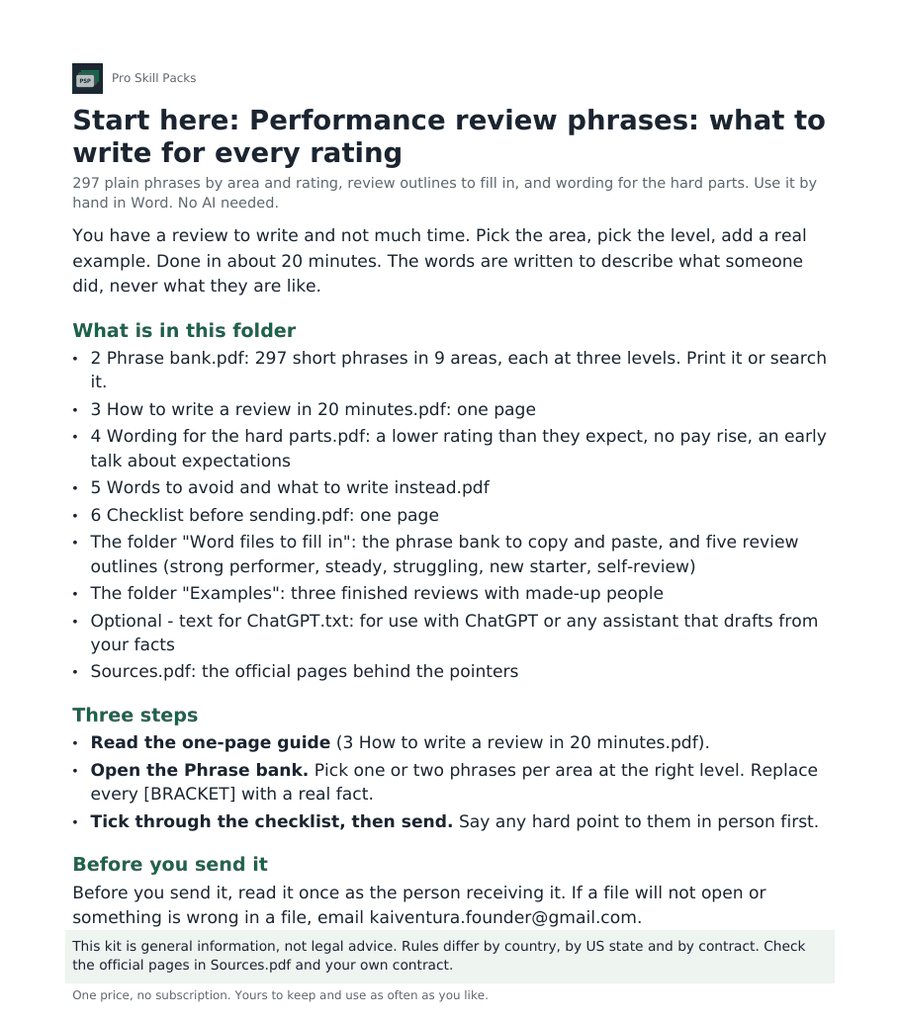
297 plain phrases for a review, at three levels, with five outlines to fill in and wording for the hard parts. Each phrase has a gap for a real example.
What is in it
- All 297 phrases: 9 areas at 3 levels each (this page shows 6 of them)
- 5 review outlines in Word (strong, steady, struggling, new starter, self-review) and 3 finished examples
- Wording for the hard parts: a rating lower than expected, no pay rise, an early talk about expectations
- Words to avoid, with what to write instead, and a 16-point checklist before sending
$9, one price, no subscription. 30-day refund. Works with no AI.
The full kit goes on sale on 6 October. Follow on Gumroad to hear when it is out.
What is job knowledge in a performance review?
The skills, facts and know-how needed to do the role well, and how the person uses them. It is not the same as quality of work, which is about the result.
How do I write a job knowledge comment?
Name the topic or tool, give one example from the period, and say what you want next. Keep it short.
How do I give a low rating for job knowledge fairly?
Say what the person already does well, name the gap, and give a plan with a date: training, a mentor, or a task to practise on.
What if the person knows more than I do?
Say so. Write what they know and how it helped the team. It is a strong, honest comment.
Questions people ask
What do I do with the [BRACKETS]?
Replace each one with a real fact: a date, a number or the name of the piece of work. If you cannot think of an example, leave the phrase out.
How many phrases are in the full kit?
297, in nine areas at three levels each. This page shows only a few of them.
Is this legal or HR advice?
No. It is general wording. If a formal step, a warning, a pay dispute or a complaint is involved, stop and speak to HR first. In the UK, Acas explains the steps.
More
- Performance review phrases for quality of work: 24 examples by rating and situation (2026)
- Performance review phrases for communication: 24 examples by rating and situation (2026)
- All the words for managing people
- Free: 20 opening lines for hard conversations
General wording, not legal or HR advice. For anything formal, speak to HR. In the UK, Acas explains the steps. Official pages read 5 October 2026.
Sources
- Acas: Reviews and appraisals, read 5 October 2026
- Acas: Problems with an employee's performance, read 5 October 2026
- EEOC: Prohibited employment policies and practices, read 5 October 2026
- Acas explains the steps, read 5 October 2026