
Find the phrases
Choose an area and a level. Each phrase has a gap for a real example.
Showing 69 of the 69 free phrases. The kit has 297, with outlines.
- Quality of work, exceedsWork is accurate and complete the first time: for example, [THE REPORT OR TASK].
- Quality of work, exceedsChecks their own work before handing it over, so very little comes back for correction: for example, [PIECE OF WORK].
- Quality of work, exceedsSets a standard others copy: for example, [WHAT THE TEAM NOW DOES BECAUSE OF THEM].
- Quality of work, exceedsNotices details others miss: for example, [THE ERROR OR GAP THEY CAUGHT].
- Quality of work, meetsWork is accurate and needs only the usual checking: for example, [THE TASK].
- Quality of work, meetsFollows the agreed steps and standards on each task: for example, [THE STANDARD].
- Quality of work, meetsCompletes tasks in full and notices when something is missing: for example, [WHAT THEY NOTICED].
- Quality of work, meetsCorrects errors quickly once they are pointed out: for example, [THE ERROR AND THE FIX].
- Quality of work, belowSome work needed correcting before it could be used: for example, [WHAT WAS CORRECTED AND HOW OFTEN].
- Quality of work, belowErrors reached [THE CUSTOMER OR THE NEXT TEAM] on [NUMBER] occasions: for example, [THE CASE].
- Quality of work, belowThe finished work often differs from what was asked: for example, [THE REQUEST AND WHAT CAME BACK].
- Quality of work, belowChecking is not yet a habit: for example, [AN ERROR A QUICK READ WOULD HAVE CAUGHT].
- Reliability, exceedsArrives on time and prepared for meetings: for example, [MEETING].
- Reliability, exceedsStart times and shift patterns have been consistent across [PERIOD]: for example, [WHAT THIS ALLOWED THE TEAM TO DO].
- Reliability, exceedsKeeps commitments, including the small ones: for example, [COMMITMENT].
- Reliability, exceedsMeets deadlines every time and tells me early when one is at risk: for example, [PROJECT].
- Reliability, meetsMeets most deadlines and says so when one will slip: for example, [TASK].
- Reliability, meetsUsually arrives on time for shifts and meetings. When plans change they tell me beforehand: for example, [OCCASION].
- Reliability, meetsGives notice when plans change: for example, [THE CHANGE].
- Reliability, meetsDoes what they say they will do: for example, [COMMITMENT].
- Reliability, meetsReplies to requests within the agreed time: for example, [THE AGREED TIME].
- Reliability, belowMissed [NUMBER] deadlines in [PERIOD]: for example, [TASK AND DATE].
- Reliability, belowProblems with deadlines were raised late, so there was little time to help: for example, [THE CASE].
- Reliability, belowArrived late to [MEETINGS OR SHIFTS] on [NUMBER] occasions in [PERIOD]. I would like to understand what would make this easier: for example, [THE DATES].
- Reliability, belowPlans change often, which makes it hard for the team to depend on the schedule: for example, [WHAT CHANGED].
- Communication, exceedsExplains complicated matters in plain words: for example, [TOPIC AND WHO THEY EXPLAINED IT TO].
- Communication, exceedsWrites emails that need no follow-up questions: for example, [THE EMAIL OR DOCUMENT].
- Communication, exceedsListens fully before responding and asks good questions: for example, [THE CONVERSATION].
- Communication, exceedsAdjusts how they speak to suit the listener: for example, [THE AUDIENCE].
- Communication, meetsWrites clearly and to the point: for example, [MESSAGE OR DOCUMENT].
- Communication, meetsReplies to messages within the usual time: for example, [TYPE OF MESSAGE].
- Communication, meetsGives updates in meetings that the team can follow: for example, [MEETING].
- Communication, meetsAsks questions when something is unclear: for example, [THE QUESTION].
- Communication, belowMessages are often long or unclear, so readers need to ask follow-up questions: for example, [THE MESSAGE].
- Communication, belowImportant information did not reach [WHO]: for example, [WHAT AND WHEN].
- Communication, belowSays little in meetings, even when they have useful views. I would like to hear more of them: for example, [TOPIC].
- Communication, belowSome messages have come across as sharper than intended: for example, [THE MESSAGE AND HOW IT WAS READ].
- Teamwork, exceedsHelps colleagues without being asked: for example, [WHAT THEY DID AND FOR WHOM].
- Teamwork, exceedsShares what they know and teaches others: for example, [WHAT THEY TAUGHT].
- Teamwork, exceedsSteadies the team when things are tense: for example, [THE SITUATION].
- Teamwork, exceedsGives others credit for their work: for example, [WHEN THEY DID THIS].
- Teamwork, meetsWorks well with the team day to day: for example, [A RECENT PIECE OF TEAMWORK].
- Teamwork, meetsDoes their share of the work: for example, [TASK].
- Teamwork, meetsHelps others when asked: for example, [THE CASE].
- Teamwork, meetsTakes part in team meetings and listens to other views: for example, [MEETING].
- Teamwork, belowTends to work alone, and the team has missed their input: for example, [PROJECT].
- Teamwork, belowHas not yet shared information that colleagues needed: for example, [WHAT AND WHEN].
- Teamwork, belowDisagreements with [COLLEAGUE OR TEAM] have slowed the work: for example, [WHAT HAPPENED]. We agreed [WHAT].
- Teamwork, belowSome tasks have been left for others: for example, [TASK AND WHO DID IT].
- Initiative, meetsGets on with their tasks without close supervision: for example, [TASK].
- Initiative, belowWaits to be told what to do next: for example, [THE OCCASION].
- Initiative, belowRaises problems but does not yet suggest a way forward: for example, [THE PROBLEM].
- Problem solving, meetsSolves routine problems without help: for example, [THE PROBLEM].
- Problem solving, belowFixes the symptom but the same problem returns: for example, [THE PROBLEM].
- Problem solving, belowAsks for help only after a long time on a problem: for example, [THE ISSUE AND HOW LONG].
- Customer focus, meetsAnswers customers politely and accurately: for example, [THE CASE].
- Leading others, exceedsGives people clear goals and checks in regularly: for example, [THE TEAM GOAL].
- Leading others, exceedsGives feedback that is specific and timely: for example, [THE OCCASION].
- Leading others, exceedsHolds regular one-to-ones that people value: for example, [WHAT TEAM MEMBERS SAID].
- Leading others, exceedsDeals with problems in the team early and directly: for example, [THE CASE].
- Leading others, meetsSets goals with the team and reviews them: [THE GOALS].
- Leading others, meetsHolds one-to-ones as planned: [HOW OFTEN].
- Leading others, meetsIs approachable: team members bring problems to them: for example, [THE CASE].
- Leading others, meetsRecognises good work in the team: for example, [THE CASE].
- Leading others, belowOne-to-ones have been cancelled or skipped: [NUMBER] times in [PERIOD].
- Leading others, belowFeedback to team members has come late or not at all: for example, [THE CASE].
- Leading others, belowTeam members have said they are unsure what is expected of them: for example, [WHAT WAS SAID].
- Leading others, belowDifficult conversations have been put off: for example, [THE MATTER].
- Learning and growth, meetsLearns the new tasks asked of them in a reasonable time: for example, [THE TASK].
No free phrase for this mix. Try another level or area. The kit has them at all three levels in all nine areas.
Pick the area and the level (exceeds, meets or below what the role needs) and see free performance review phrases you can copy. Each has a gap for a real example.
How to use these
- Pick the phrase that matches what you saw.
- Replace every [BRACKET] with a real fact: a date, a number or the name of the piece of work.
- If you cannot think of an example, leave the phrase out.
- Read the finished review once as the person who will receive it.
What to avoid
- Do not copy a phrase you cannot back with an example.
- Do not leave a bracket in the text you send.
The law in many places protects people from unfair treatment linked to things like age, disability, sex, race, religion or belief, sexual orientation, pregnancy and maternity. Do not mention these in a review, and do not guess at them.
Official pages. Not legal or HR advice. If a formal step, a warning, a pay dispute or a complaint is involved, stop and speak to HR first.
- Acas: Reviews and appraisals (what a review is for), read 5 October 2026
- Acas: Problems with an employee's performance (how employers should handle performance and conduct problems), read 5 October 2026
- Acas: contact and helpline (free advice) (free advice), read 5 October 2026
- EEOC: Prohibited employment policies and practices (pointer only, for US readers), read 5 October 2026
UK readers: the free Acas helpline is on its contact page. US readers: see the EEOC page and your employer's HR team.
New free pages by email. A few a month. Unsubscribe any time.
FollowHandled by Gumroad. See our privacy page.
What the full kit adds
This page shows 69 of the 297 phrases. The kit has the rest, and the files you fill in.
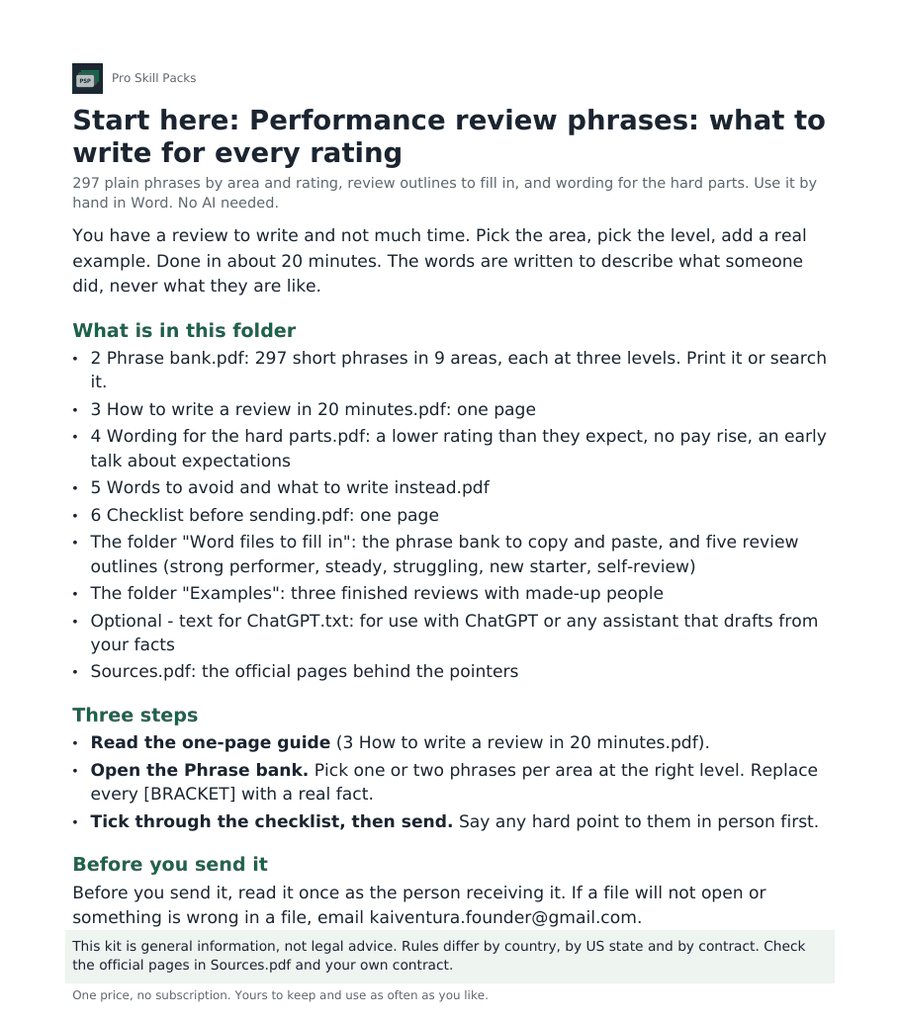
Performance review phrases: what to write for every rating
297 plain phrases for a review, at three levels, with five outlines to fill in and wording for the hard parts. Each phrase has a gap for a real example.
What is in it
- All 297 phrases: 9 areas at 3 levels each (this page shows 69 of them)
- 5 review outlines in Word (strong, steady, struggling, new starter, self-review) and 3 finished examples
- Wording for the hard parts: a rating lower than expected, no pay rise, an early talk about expectations
- Words to avoid, with what to write instead, and a 16-point checklist before sending
$9, one price, no subscription. 30-day refund. Works with no AI.
Questions people ask
What is a good performance review phrase?
One that says what the person did, in plain words, with a real example. Pick the phrase for the level you saw, then replace the bracket with the actual task, date or number.
What are the levels?
Exceeds: more than the role needs. Meets: what the role needs. Below: less than the role needs. The phrases are written to match what you saw, so choose the level from the evidence, not from a wish.
Do I have to use every phrase?
No. Pick the few that fit and leave out any you cannot back with an example. A phrase with its bracket left empty is not ready to send.
How many phrases are free here?
69 of the 297 in the kit, spread over the nine areas. Some areas show only a few. The kit has all nine areas at three levels, with review outlines in Word and wording for the hard parts.
Is this legal or HR advice?
No. It is general wording. If a formal step, a warning, a pay dispute or a complaint is involved, stop and speak to HR first. In the UK, Acas explains the steps.
More
- Performance review phrases for communication: 24 examples by rating and situation (2026)
- How to write a performance review in 20 minutes
- All the words for managing people
General wording, not legal or HR advice. Official pages read 5 October 2026.
Sources
- Acas: Reviews and appraisals, read 5 October 2026
- Acas: Problems with an employee's performance, read 5 October 2026
- Acas: contact and helpline (free advice), read 5 October 2026
- EEOC: Prohibited employment policies and practices, read 5 October 2026