
3 emails you can copy
A breakup email is the last note after a few with no reply. These three are short and polite. Replace every [BRACKET] with a real fact.
- Closing it politelySubject: Closing the loop on [TOPIC]Hi [FIRST NAME], I have written [NUMBER] times about [TOPIC] and have not heard back. That is fine, and I will stop writing now. Should I check back in [MONTH]? If not, just say no, or ignore this, and I will not write again. [YOUR NAME]
- Asking for another contactSubject: Someone else at [COMPANY]?Hi [FIRST NAME], I will take you off my list for [TOPIC] unless you tell me otherwise. If someone else at [COMPANY] should hear about it, I would be glad of their name. If nobody should, that is fine too. [YOUR NAME]
- When a proposal went quietSubject: Your [PROPOSAL] from [DATE]Hi [FIRST NAME], I have not heard back about the [PROPOSAL] I sent on [DATE], so I will assume the timing is not right and stop following up. If things change, reply to this email and we can pick up where we stopped. [YOUR NAME]
Subject lines
- Subject lineClosing the loop on [TOPIC]
- Subject lineSomeone else at [COMPANY]?
- Subject lineYour [PROPOSAL] from [DATE]
Why this works
- Send it only after two or three earlier emails with no reply.
- Say plainly that you will stop.
- Give one easy reply: a month to check back, a name, or "no".
- Then really stop. Do not add them to another list.
What to avoid
- Do not write "I guess you are not interested" or anything that tries to make them feel bad.
- Do not call it a last chance, and do not invent a deadline.
- Do not use a joke that mocks them, such as a picture of a sad animal.
- If they reply "no" or "stop", write back once to say thank you, then do not email again.
Official pages. Rules for commercial email differ by country. Not legal advice: check the rules that apply to you.
- United States: FTC: CAN-SPAM Act: A Compliance Guide for Business. It says the law covers all commercial email, with no exception for business-to-business email, and lists what each message needs, read 5 October 2026.
- United Kingdom: ICO: Electronic mail marketing. It says you must not send marketing emails to individuals without specific consent, that you can send marketing emails to companies, and that it is good practice to keep a do-not-email list of companies that object. The ICO says the page is under review. Read 5 October 2026.
What the tools add
The first is free. Start there.
Cold Email Checker
Paste your draft and the text of the prospect's page. It tests every claim about them against that text, flags claims about you that need proof, and checks the subject line, the single ask and the length. It lists the commercial email basics from the US FTC's CAN-SPAM guide that the draft is missing. You get a verdict, a claims table, quoted issues and a tightened version with unsupported claims removed.
Cold Email from a Website
What you give it: a company's website address and a line on what you sell. If you have a proof point, add it, and you confirm it is true.
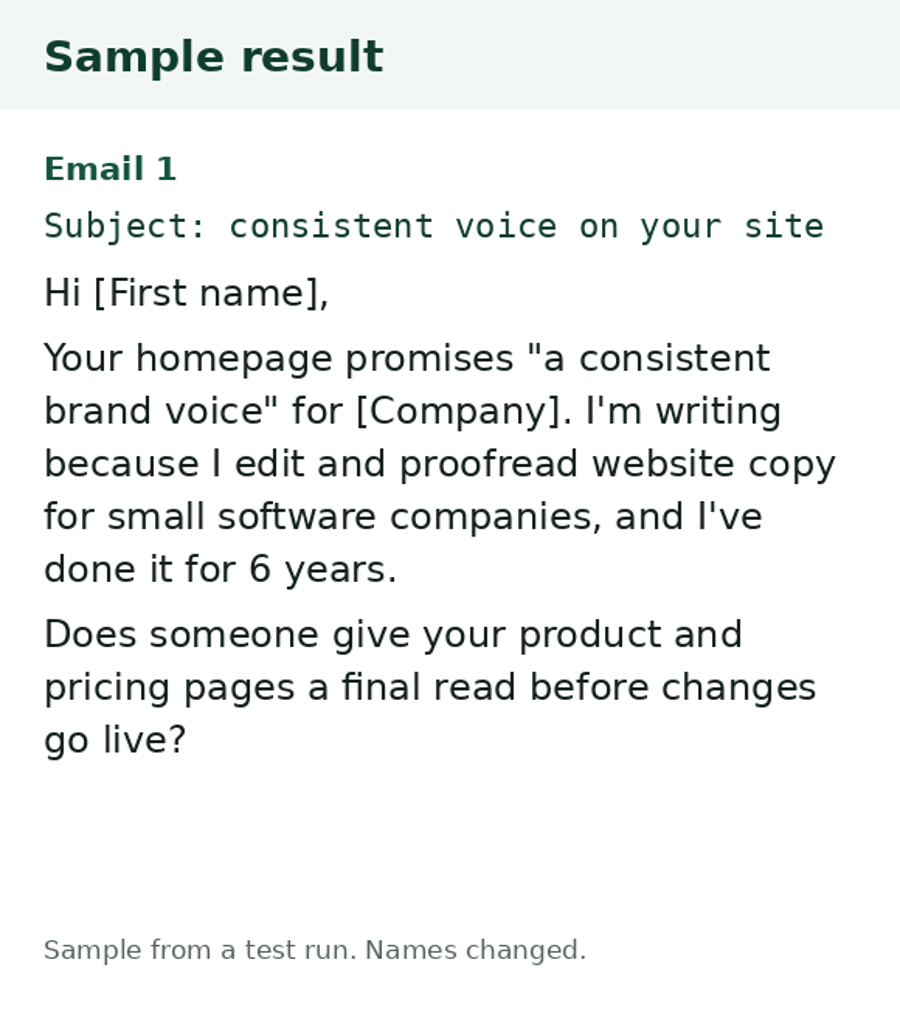
What you get: a three-email sequence and two subject lines, each built on something visible on their site, with the page it came from, and a list of what to check before sending.
$9, one price, no subscription. It reads up to three public pages, does not find email addresses, and does not send anything.
Questions people ask
What is a breakup email?
The final email in a run of follow-ups. It tells the person you will stop writing and gives them one easy way to answer.
Do breakup emails work?
Sometimes people reply to a clear, short close when they ignored the earlier emails. We have no numbers to give you, and we do not promise a reply.
Should I send one at all?
It is optional. It is polite to say you are stopping, and it leaves the door open. If they asked you to stop, do not send one: just stop.
How long after the last email?
About the same gap as before, three to five working days. Do not send it the next day.