
4 emails you can copy
Four follow-ups for four different situations. Send them in the same thread as the first email, so the subject stays as you sent it. Replace every [BRACKET] with a real fact.
- A short reminderSubject: [SAME SUBJECT AS YOUR FIRST EMAIL]Hi [FIRST NAME], On [DAY] I wrote about [ONE-LINE REASON YOU CONTACTED THEM]. Inboxes fill up, so I am sending this once more. Is this something [COMPANY] looks at, or should I ask someone else? Either answer helps. [YOUR NAME]
- Adding one useful thingSubject: [SAME SUBJECT AS YOUR FIRST EMAIL]Hi [FIRST NAME], One more note on [TOPIC]. [ONE FACT, LINK OR EXAMPLE THAT YOU CAN BACK UP AND THAT RELATES TO THEIR WORK]. If it would help, I can send [WHAT YOU WOULD SEND]. If not, there is no need to reply. [YOUR NAME]
- Asking for the right personSubject: Who looks after [AREA] at [COMPANY]?Hi [FIRST NAME], I may have written to the wrong person. I am looking for whoever handles [AREA] at [COMPANY]. Could you point me to them? If it is you and the timing is wrong, say so and I will stop. [YOUR NAME]
- The last noteSubject: [SAME SUBJECT AS YOUR FIRST EMAIL]Hi [FIRST NAME], I have written twice about [TOPIC] and have not heard back, so I will stop here. If [TOPIC] becomes a priority later, you can reach me at [EMAIL OR PHONE]. [YOUR NAME]
Subject lines
- Subject lineFollowing up on [TOPIC]
- Subject lineWho looks after [AREA] at [COMPANY]?
- Subject line[TOPIC] at [COMPANY]: still relevant?
Why this works
- Wait 3 to 5 working days. Reply in the same thread so they can see your first email.
- Say in one line why you wrote. They may not remember.
- Give them an easy answer: yes, no, or a name.
- Add one new thing each time, or write less. Do not repeat the first email.
- Stop after two or three follow-ups.
What to avoid
- Do not write "just checking in" or "bumping this to the top of your inbox". It says nothing.
- Do not guilt them: "I guess you are not interested" or "I have not heard back from you" as a complaint.
- Do not invent a deadline, an offer that ends, or other people "looking at it".
- Do not use "Re:" or "Fwd:" in a new subject. Only reply in a real thread.
Official pages. Rules for commercial email differ by country. Not legal advice: check the rules that apply to you.
- United States: FTC: CAN-SPAM Act: A Compliance Guide for Business. It says the law covers all commercial email, with no exception for business-to-business email, and lists what each message needs, read 5 October 2026.
- United Kingdom: ICO: Electronic mail marketing. It says you must not send marketing emails to individuals without specific consent, that you can send marketing emails to companies, and that it is good practice to keep a do-not-email list of companies that object. The ICO says the page is under review. Read 5 October 2026.
What the tools add
The first is free. Start there.
Cold Email Checker
Paste your draft and the text of the prospect's page. It tests every claim about them against that text, flags claims about you that need proof, and checks the subject line, the single ask and the length. It lists the commercial email basics from the US FTC's CAN-SPAM guide that the draft is missing. You get a verdict, a claims table, quoted issues and a tightened version with unsupported claims removed.
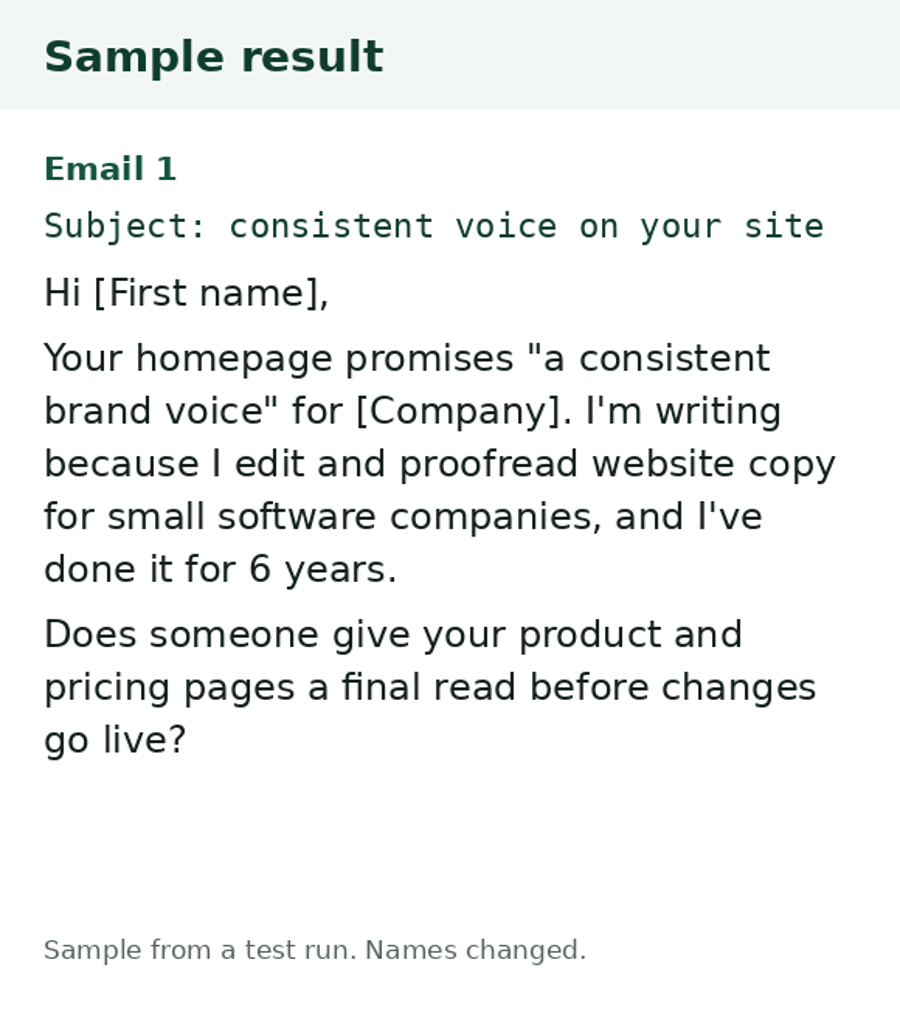
Cold Email from a Website
What you give it: a company's website address and a line on what you sell. If you have a proof point, add it, and you confirm it is true.
What you get: a three-email sequence and two subject lines, each built on something visible on their site, with the page it came from, and a list of what to check before sending.
$9, one price, no subscription. It reads up to three public pages, does not find email addresses, and does not send anything.
Questions people ask
How long should I wait before I follow up?
Three to five working days is a common choice. There is no rule. Pick a gap you would not mind receiving yourself, and keep it the same every time.
How many follow-ups are too many?
Two or three. After that, send a closing note (see the breakup email page) or stop. If they ask you to stop at any point, stop and do not write again.
Should the follow-up be in the same thread?
Yes, when the first email was sent to the same person. They can see what you wrote. Change the subject only when you are asking someone new.
What if I have nothing new to say?
Then keep it to two sentences: why you wrote, and an easy way out. A follow-up with no new point should be short.